


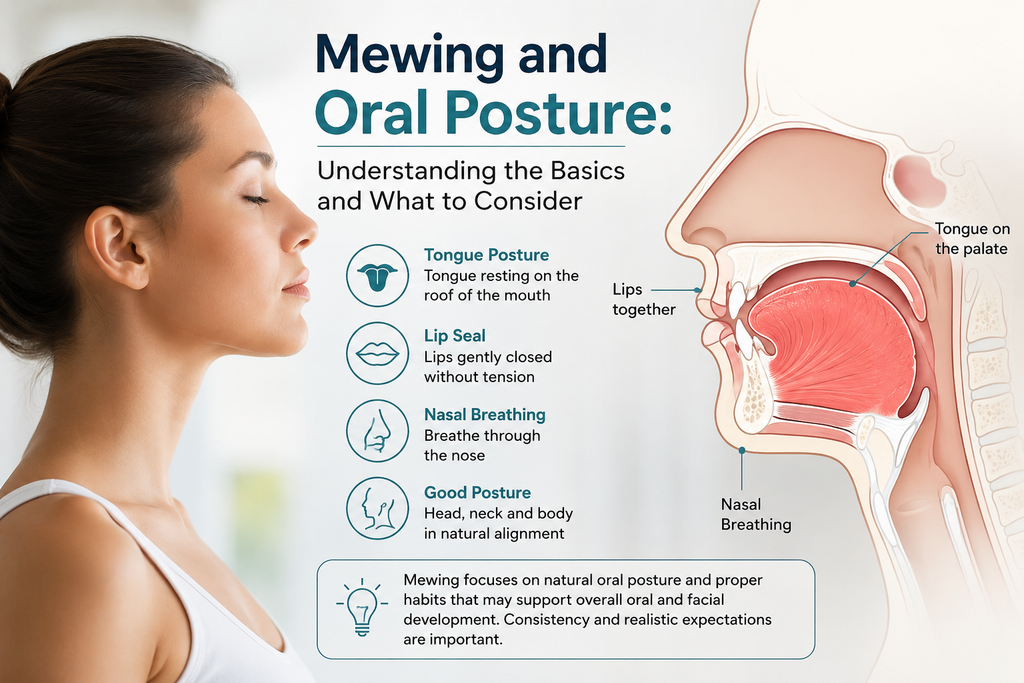
Mewing is an online phenomenon related to facials, jawlines, and mouth position. It is essentially described as placing the tongue on the roof of the mouth. Some people believe that if you hold this position, you can subtly alter your lower facial structure and jaw over time.
Most of the popularity behind Mewing is created by quick explanations and “evidence” that is posted to social media (i.e., “before” and “after” pictures). The American Association of Orthodontists has stated that there is no evidence that mewing changes how the jawline is structured or can completely replace the need to get braces and orthodontics.
The lack of evidence does not mean that tongue placement is irrelevant. The lips, teeth, and jaws work in unison with the tongue to form a system. The resting position of these structures and how you change their position to swallow and breathe can affect how your oral system functions.
The biggest issue is that most people think that placing the tongue in a specific position will change their oral function, but most of the time, it probably won’t.
What Does Normal Oral Posture Involve?
Oral posture describes the resting positions of the lips, tongue, and jaw. Oral posture can’t be reduced simply to one optimal resting position.
As described by the American Speech-Language-Hearing Association, typical oral resting posture consists of closed lips, teeth slightly apart, and nasal breathing with the tongue in an undefined resting position relative to the palate and surrounding structures.
This rest position of the oral structures is important because the individual components of the oral cavity provide more than just aesthetics. The tongue retracts and coordinates many forms of swallowing, and speech along with many other movements that occur throughout the day. Jaw and lip movements are also important for the coordination of oral activities.
Breathing is also important. Persistent mouth breathing can result in changes in resting positions of the lips, jaw, and the tongue, but causes of mouth breathing can be varied. Excluding allergies and obstructions of the nasal airways and other airway-related factors, it is not wise to try to just keep the mouth closed.
What Does a Typical Mewing Technique Involve?
The aim of the Mewing technique is to reverse the natural downward relaxation of the tongue by pushing the tongue up to the roof of the mouth. Many advise the practicing of the technique to include the sealing of the lips and the practice of breathing through the nose.
It is helpful to understand that voluntarily pushing the tongue against the roof of the mouth should be replaced with the guided relaxation of the tongue.
It would be inaccurate to state that the tongue has to be pressed in order to maintain a resting position on the roof of the mouth. Pressing the tongue up to the roof of the mouth, for an extended period of time, can cause unnecessary stress and can even begin to be painful to the teeth. The AAO notes that such stress can be detrimental to the positioning of the teeth and can change the position of the teeth and even affect the Jaw.
Users should also be careful with instructions found online that promote high levels of pressure and rapid changes to the face.
What Should You Consider Before Trying It?
Anyone interested in oral posture should start by separating reasonable questions from exaggerated online claims.
A few points are worth keeping in mind:
- Tongue posture is only one part of oral function.
- A comfortable resting position is different from deliberately applying force.
- Facial appearance is influenced by genetics, growth, bone structure and many other factors.
- Mewing has not been established as a replacement for orthodontic treatment.
- Persistent mouth breathing may have an underlying cause that needs assessment.
- Changes in tooth position or bite should not be attempted without professional guidance.
Jaw discomfort, changes in bite, breathing through the nose difficulty, changes in speech, and other persistent symptoms following the practice should prompt an end to the practice and a trip to the professional to find out what is happening to the body.
When Is a Dental or Orthodontic Evaluation Useful?
The advice of a professional can be sought if one has concerns regarding tooth alignment, jaw development, breathing or swallowing and if there are problematic oral habits.
An orthodontist can assess the relationship between the teeth and jaws and can determine whether there is a problem that may warrant orthodontic work. If there are other concerns, then additional professionals may also be needed. ASHA (2017) states that an orofacial assessment may require collaborative effort between an orthodontist, dentist, physician, ENT, and SLP.
This way is more productive than trying to figure out the reason for the issue from posts made on social media.
We must also keep in mind that a professional evaluation does not automatically lead to intervention. Sometimes the appropriate intervention is breathing treatment, advice regarding oral function, or just observing and monitoring.
If you’re exploring these options or have concerns about oral function, tongue posture, jaw development, or orthodontic treatment, consult a qualified orthodontist for a personalized evaluation and guidance.
Contact Dr. Mathesul Invisalign Orthodontist Braces & Dental Implant Clinic to discuss your concerns and understand which approach may be appropriate for you. Take the first step toward better oral health and informed orthodontic care.
Call us today at 8983101099 or email us at dailydentist@gmail.com to book your consultation. Take the first step toward better oral health and get professional guidance on your orthodontic treatment options.
Here’s the Location Link:
Conclusion
Many think mewing and oral posture are simple, but they are actually complex. The mouth and breathing systems are interconnected with the tongue, lips, teeth, and the jaw in a variety of ways. Changing the position of your tongue will not affect the shape of your face or your braces.
To address your individual concerns about your bite, jaw, breathing, and the position of your tongue, you have to look in the mirror. Book an appointment if you have any doubts. orthodontic or dental points. They will assess your x-rays and let you know what next steps are appropriate.
