


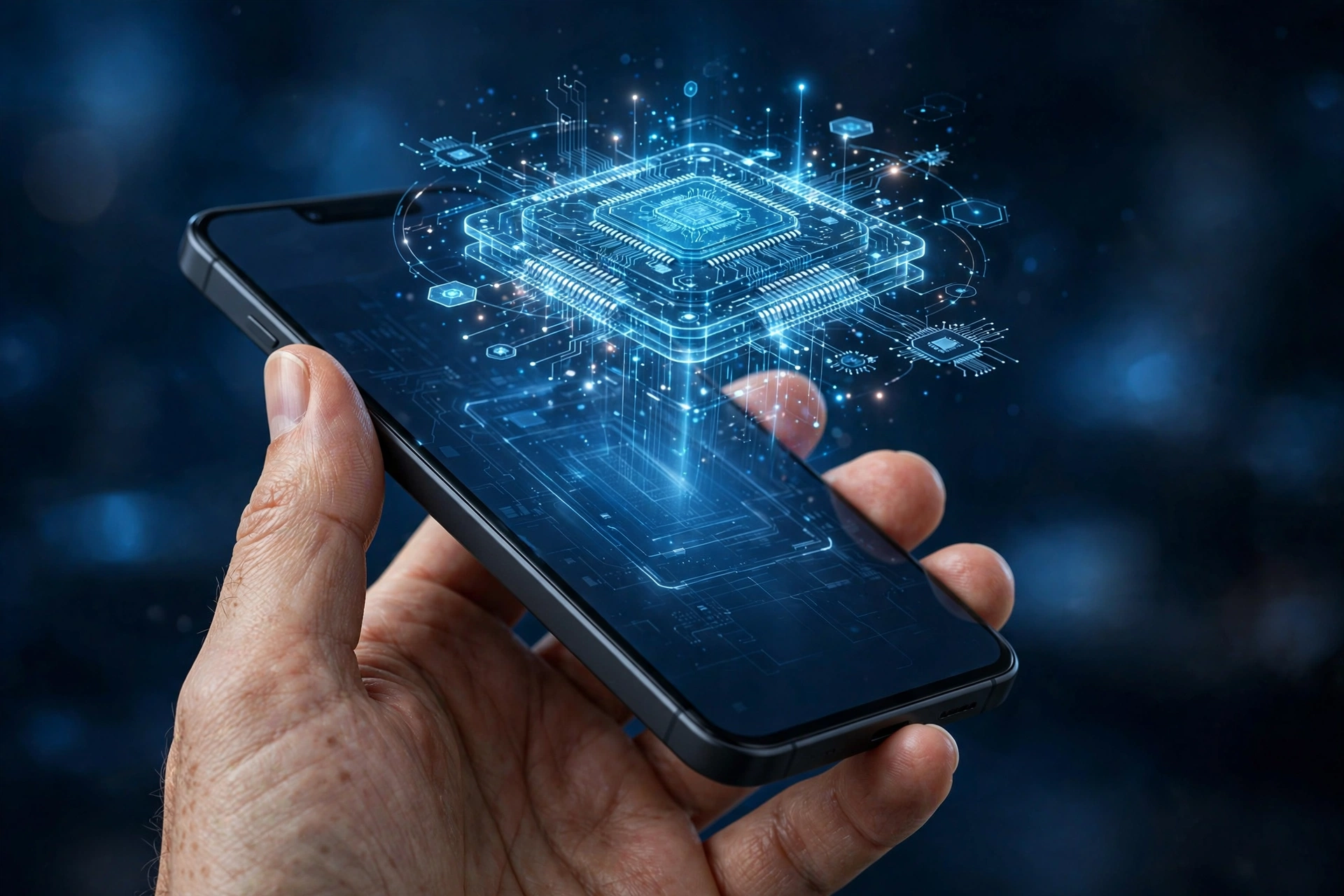
The most important smartphone upgrade of 2026 is not a camera or a screen. It is invisible: artificial intelligence that runs entirely on the phone itself. After two years of cloud-based AI features that sent your data to distant servers, the industry has pivoted hard toward on-device processing — and the change is reshaping how phones are designed, sold and used.
Why the Cloud Was Not Enough
Cloud AI has three weaknesses that no amount of server power can fix. The first is latency: a round trip to a data centre makes voice assistants feel sluggish. The second is availability: no signal means no smarts, which is a problem on planes, trains and anywhere rural. The third is privacy. Users have grown wary of sending messages, photos and health data off their devices, and regulators have noticed.
On-device AI answers all three. Modern flagship processors now ship with neural engines capable of running genuinely useful language and image models locally. At FourFiveTech we have tested this year’s flagships side by side, and the gap between “phone with AI” and “phone that thinks” is closing fast. Coverage of the wider shift is a staple of outlets such as BBC Technology, which has tracked the race throughout 2026.
What On-Device AI Actually Does Well
The standout features share a pattern: personal, frequent and time-sensitive. Live translation during phone calls now happens without a network connection. Photo editing — removing photobombers, relighting portraits, extending backgrounds — completes in seconds rather than uploading to a server. Summaries of your own messages, notifications and recordings are generated privately, because the model can see your data without your data leaving the device.
Accessibility has quietly become a killer use case. Real-time captions, voice isolation on calls and scene descriptions for visually impaired users all work better, and more privately, when processed locally.
The Hardware Arms Race Underneath
Running AI locally is brutally demanding, and it is driving the spec sheet. Phones now ship with 12GB or 16GB of RAM as standard in flagship tiers because language models need memory headroom. Chipmakers compete on tokens-per-second and performance-per-watt rather than raw benchmark scores. Battery impact is the engineering battleground: the best current devices can handle a day of mixed AI features with only a modest hit, something that was not true even eighteen months ago.
There is a mid-range story too. Features that debuted on premium phones are cascading down quickly, and by the end of 2026 capable on-device AI is a realistic expectation at half the flagship price.
Related reading: How CPAs Simplify Complex Financial Statements
What Still Belongs in the Cloud
On-device models are small by necessity, and small models have limits. The largest frontier models — the ones that write long documents, reason through complex research or generate video — will live in data centres for years yet. The emerging pattern is hybrid: the phone handles the personal and the immediate, quietly escalating to the cloud only when a task genuinely needs it, ideally with clear permission.
That hybrid split also has a business dimension. Cloud AI costs manufacturers money every time you use it; on-device AI costs them once, in the chip. Expect subscriptions to keep pushing cloud features while the free tier quietly migrates onto the device.
How to Judge Your Next Phone
If you are shopping this year, look past the AI branding. Check the RAM, check how many of the headline features work in aeroplane mode, and check the manufacturer’s policy on how long AI features will be supported. The phones that age best will be the ones whose intelligence lives on the device — private, instant and entirely yours.
The Privacy Dividend
There is a final advantage that rarely leads the marketing but may matter most in the long run. When AI runs on your device, the relationship between you and your data changes fundamentally: your photos, messages and voice never need to leave your pocket to be useful. That makes whole categories of features — health insights, personal memory search, financial summaries — possible in a way that cloud processing never quite allowed, both legally and in terms of user trust.
Regulators in Europe and elsewhere are actively encouraging this direction, and enterprise buyers now ask pointed questions about where AI processing physically happens. The smartphone in your pocket is becoming a private data centre. This year’s models are the clearest sign yet that the future of AI is not just bigger — it is closer.
