


Personalised medicine often sounds like a slogan. In the case of NeoVax, it is a manufacturing process: sequence a patient’s tumour, identify the mutations that make it recognisably abnormal, build a vaccine around those signals, and give it with a drug that keeps the immune system switched on. A phase 1 trial published in Nature Medicine has now tested that process in platinum-sensitive ovarian cancer, reporting that the vaccine-plus-nivolumab combination was feasible to deliver and had an acceptable safety profile.
For a technology-minded reader, the trial is interesting twice over: once as oncology, and once as logistics. Producing a unique medical product for every single participant, on a clinical timetable, is an engineering challenge as much as a biological one — and this study suggests the pipeline can work.
From biopsy to bespoke vaccine
The process starts with tumour and blood samples. Sequencing software compares them to find neoantigens — protein fragments that exist because of cancer mutations and appear nowhere in healthy tissue. Prediction algorithms rank which fragments the patient’s immune system is most likely to notice, and a vaccine is manufactured containing the top candidates. Each step — sequencing, prediction, production, quality control — must finish while the patient remains well enough to benefit.
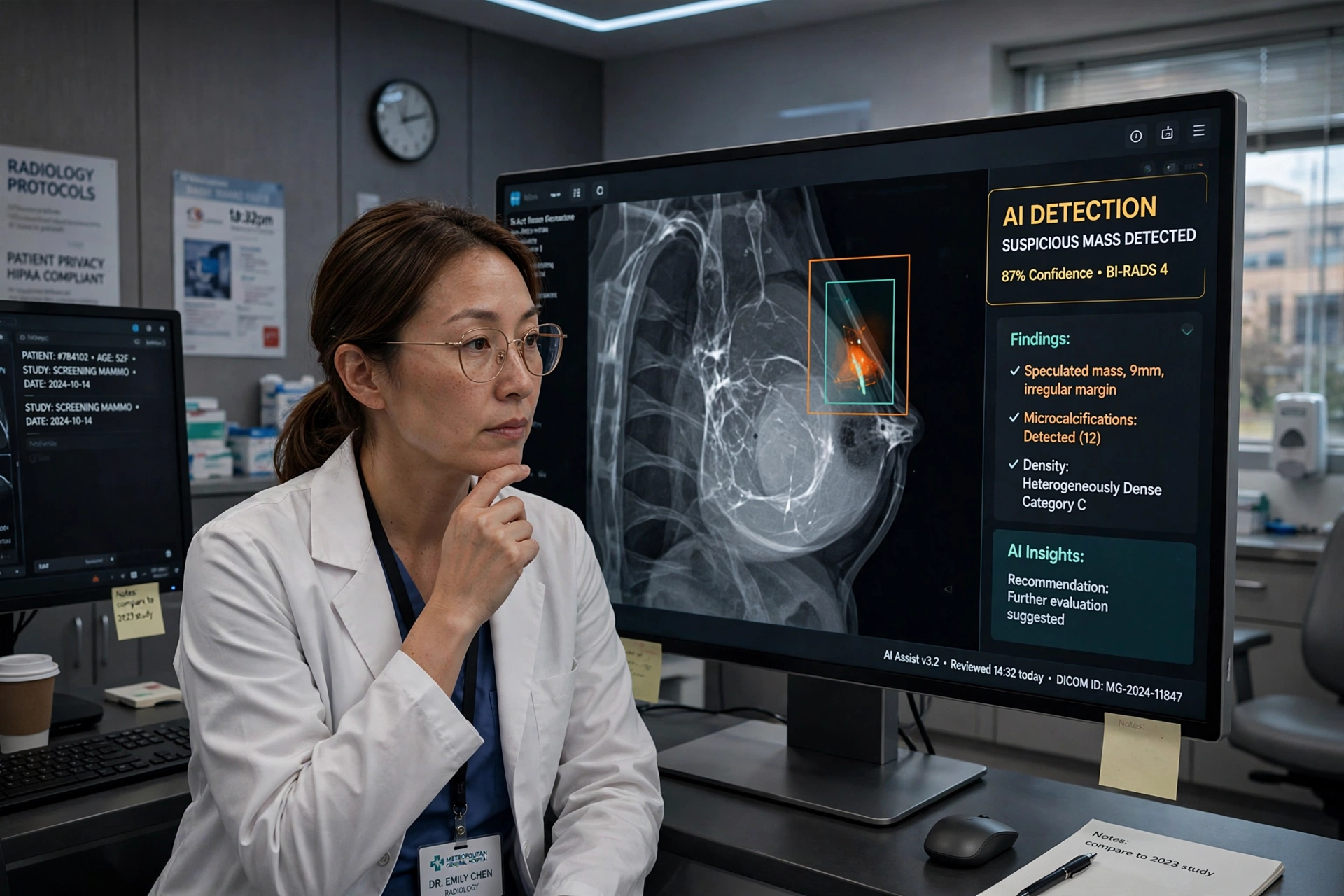
It is the same pattern reshaping other corners of medicine, where computation guides an intervention tailored to one person; compare our feature on how technology is changing breast cancer detection, where algorithms similarly sort signal from noise. NeoVax simply pushes the idea further: the algorithm’s output becomes the drug itself.
Why pair a vaccine with nivolumab?
A vaccine can teach T cells what to attack, but tumours defend themselves by engaging checkpoint molecules that tell T cells to stand down. Nivolumab blocks one of those checkpoints, PD-1, and is already used across several cancers. Combining the two is a deliberate systems design: one component supplies recognition, the other removes suppression, and together they aim for a stronger, longer immune response than either might achieve alone.
The trial’s detailed results, including safety data, are published through Nature Medicine. As the authors themselves stress, the design tests feasibility and tolerability first; it was never sized to prove the combination extends survival.
What ‘acceptable safety’ really tells investors of hope
In trial language, acceptability means the side-effect burden did not cross pre-set lines that would halt development. Checkpoint inhibitors can trigger immune attacks on healthy organs, so demonstrating that adding a personalised vaccine did not make the combination unmanageable is the essential gate this study had to pass. Manufacturing success matters equally: a vaccine that arrives too late, or cannot be produced reliably, fails as a product no matter how elegant its science.
Both gates, the researchers report, were passed in this small group. That justifies the expense of a larger randomised trial — the only design that can separate the vaccine’s contribution from nivolumab’s and from patients’ previous chemotherapy responses.
The road from phase 1 to pharmacy is long
Most experimental cancer therapies that clear phase 1 still never reach approval, because efficacy in controlled trials is a far sterner test than safety in a handful of volunteers. Personalised vaccines face extra questions too: cost per patient, factory capacity, turnaround time, and whether regulators can standardise approval for a product that differs every time it is made. Each is solvable in principle; none is solved by one early study.
The measured conclusion, then, is that the technology pipeline held together under real clinical conditions — sequencing, prediction, manufacture, vaccination and checkpoint therapy, delivered as one coordinated system to women with a difficult cancer. That is a meaningful engineering and medical milestone. Whether it becomes a life-extending treatment now depends on trials designed to answer the harder question, with control groups, more patients, and time.
There is a further technology angle worth watching: the prediction algorithms at the heart of NeoVax keep improving as more patient data links chosen neoantigens to actual immune responses. Each trial therefore improves the software as well as testing the medicine, so even a combination that stalls could leave the platform smarter than it found it.
